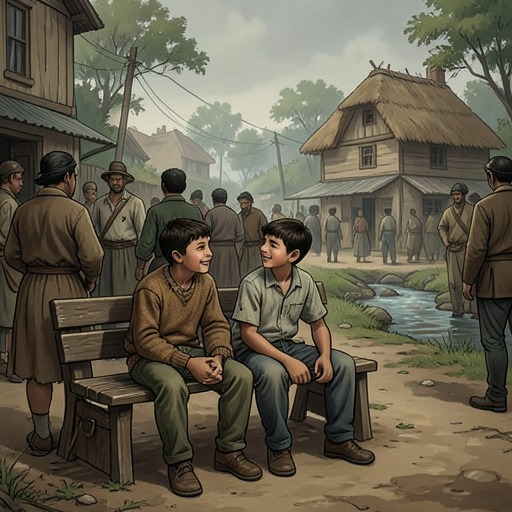
Fintan Slattery
Angela's AshesFintan Slattery is a schoolboy at Leamy’s National School whose conspicuous devotion sets him apart from his classmates. His certainty about religion, his aspiration to become a saint, and his fastidious habits invite mockery; yet when he shares the reward he has actually won, he names Quigley, Clohessy, and McCourt as his friends. Through Fintan, the narrative places sincere piety beside the poverty and hunger that his visitors bring into his home.
Identity and religious background
Fintan’s knowledge of religious teaching is made visible in class: when the teacher asks who stood at the foot of the cross, Fintan raises his hand to answer. His confidence has a household context. He and his mother pray the rosary on their knees in the kitchen each night, read Catholic publications, attend Mass and Communion in all weather, and confess each Saturday to the Jesuits. His father has gone to Canada to cut trees and is not heard from again, leaving Fintan and his mother to inhabit a daily life organized around religious practice.
His mother’s neighbors call her Mrs. Offer-It-Up because she treats hardship—including a broken leg, spilled tea, or her husband’s disappearance—as something to offer to God in exchange for indulgences. Fintan adopts a similar response to insult. If boys push him or call him names, he smiles and says that he will pray for them and offer the affront for both their souls. The schoolboys do not welcome his prayers; they threaten to beat him if they catch him praying for them. His faith is thus not merely private belief but a public manner that provokes the very hostility he claims to answer with charity.
Schoolroom conduct and the apple peel
Fintan says he wants to be a saint when he grows up and imagines that future grandchildren will pray to his picture. The boys answer his aspiration with a crude threat to defile it. His sister has run away to England, and the other boys know that at home he wears her blouse and curls his hair with hot tongs on Saturday nights so he will look beautiful at Mass. He calls his hair gorgeous, a word none of the other boys will use. The narration presents these details through the boys’ amused, sometimes cruel attention, while showing how deliberately Fintan prepares himself for the Sunday service that matters to him.
In class, Fintan correctly identifies the three Marys as those who stood at the cross and is called forward for a reward. Rather than devour his apple like the other winners, he uses a pocketknife to cut its peel into small pieces and eats them one by one. The teacher insists that he has only the peel, not the apple itself, and pointedly denies him any prospect of reaching the heights represented by the fruit. Fintan nevertheless asks to give away three pieces of his reward, naming Quigley, Clohessy, and McCourt. Asked why, he answers that they are his friends. The smallness of what he offers is inseparable from the generosity of offering it: his gesture is real, but the teacher has already made the limits of his prize unmistakable.
Friendship and the visit to his home
Fintan brings Frank McCourt and Paddy Clohessy to his house on the feast day of Saint Francis of Assisi, which falls on October 4. He explains that Saint Francis is Frank’s patron and says that on the feast day Frank can ask the saint for anything. Fintan’s invitation turns religious knowledge into a personal welcome: he has brought Frank there for a particular occasion and seats him with Paddy.
Fintan’s mother receives the boys warmly and offers cheese sandwiches. Seeing Paddy’s injured nose, she touches it with the cross on her rosary and says a prayer; she also tells them that the beads were blessed by the Pope and could stop a river if asked. Fintan refuses a sandwich because he is fasting and praying for the boy who struck Paddy and Frank. His mother kisses his head and calls him a saint out of heaven. Around this exchange, the narration registers the difference between the Slatterys’ confidence in devotional remedies and the boys’ bodily circumstances: Paddy’s nose is hurt, while he has never had a sandwich in his life.
The boys who see the three leave together call Frank and Paddy Fintan’s “ingles.” At Fintan’s kitchen table he offers access to comic books and magazines, including religious publications and his mother’s romance magazines. Paddy dismisses the romance stories as nonsense. Meanwhile, Fintan’s own meal is laid out under a cloth: a ham sandwich with mustard and a glass of milk. He cuts the sandwich into progressively smaller pieces, reads The Little Messenger of the Sacred Heart while eating, drinks the milk, leaves pieces of sandwich on the plate, wipes his lips, says grace, and blesses himself with holy water before going back to school.
Contrast, hunger, and narrative role
The visit does not end in shared food. Fintan finishes his milk and covers the remaining sandwich pieces, while Frank and Paddy watch and hope he will pass the plate to them. He does not. By the time they leave, it is too late for them to get the bun and milk available from Nellie Ahearn. Frank is left wondering how he will last until he can get bread at home, and Paddy stops at the school gate because he cannot face going in hungry. The scene preserves the moral complexity of Fintan’s charity: he has offered apple peel to friends, welcomed them into his home, and fasted for the boy who hurt them, but his private meal remains his own even as his guests go hungry.
Fintan is drawn through repeated, concrete rituals rather than through an account of inner change: the rosary, Saturday confession, carefully curled hair, the pocketknife, the covered sandwich, the meal prayers, and the holy water at the door. These habits make his devotion both visible and comic to the boys, but they also distinguish his sense of obligation from their material need. The apple-peel episode gives his claim of friendship a precise and limited form; the kitchen visit then tests that generosity against hunger without turning him into either a simple hypocrite or an unqualified benefactor. In Frank’s recollection, Fintan’s piety and the boys’ deprivation occupy the same small domestic scene, and their coexistence is the point.